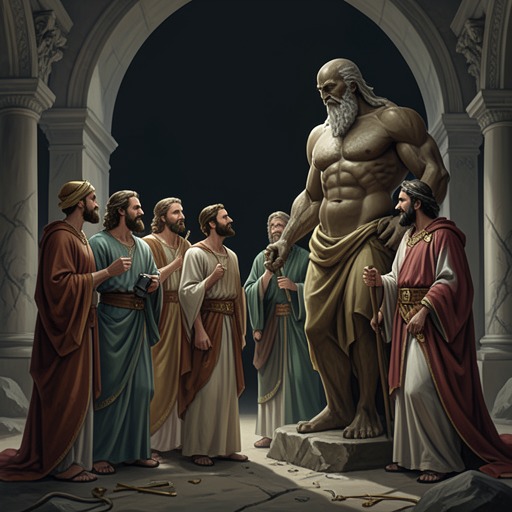
Neyar chooses to leave the System
Systema Delenda EstNeyar chooses to leave the System at the point where political defiance has become indistinguishable from risking the destruction of his people. The decision is not presented as a conversion to Cato’s cause or as a sudden rejection of everything the System provides. It is a strategic secession: Neyar accepts that independence is the only remaining way to preserve his four worlds, his people, and their lineage from pressures exerted by the Core, the Nine Great Clans, and the approaching crisis.
Causes and Political Pressure
Mii-Es and Initik frame the proposal as a choice between two kinds of danger. They warn Neyar to move before the Core does, taking his worlds out of the System while he still has the ability to decide the terms. Misse has already been probing their position through Meshan’s world, and the weakening of the informal restraints among the Nine Great Clans threatens to bring the pressure directly against Neyar’s possessions. Secession would end his need to push back against the Great Clans and remove the proxy skirmishes through which outside powers continually test his defenses.
Initik’s support is practical rather than sentimental. He has observed what Cato can do and believes Cato is not primarily interested in conquest, making a negotiated settlement preferable to one imposed after military defeat. Mii-Es likewise presents independence as a way to remove the Great Clans’ hold, even though it would mean accepting a future unlike the one Neyar has known. Neyar initially bristles at the suggestion because treating with Cato is distasteful and dangerous, but he also understands what Misse can do as a Core Deity. The political alternatives have narrowed until conversation becomes less a gesture of trust than a necessary instrument of survival.
Negotiation with Cato
Neyar agrees to speak with Cato through Initik’s device. Cato appears in a form resembling some of the Ahruskians, though not exactly matching any of them, and adopts a deliberately modest diplomatic presentation. Neyar immediately recognizes that the unimpressive appearance is likely a deception or a concession to negotiation rather than evidence of weakness. Cato offers hopes of reaching an agreement without harm to Neyar or his people, while Neyar answers with suspicion and points out the administrative problem at the center of the proposal: he rules four worlds, and without the deity connection or the portals he cannot effectively govern them all.
Cato’s answer is deliberately open-ended. Neyar may not be able to be in four places at once now, Cato suggests, but he might be able to do so after the transition. The offer therefore concerns more than escape from System control. It promises a different infrastructure of coordination, one in which the loss of System authority need not mean the disappearance of administration, communication, or collective direction.
The negotiations become more contentious when Kolokol asks whether Neyar intends to reject an agreement merging his worlds with those of the Hokar Clan. Neyar refuses to treat his planets as strategic pieces that can be exchanged by outsiders. To Cato and the other negotiators, the worlds have military and logistical value; to Neyar, they are home, work, and lineage. He rejects the idea that any abstract offer could compensate his people for surrendering them, even comparing the demand to asking whether Hokar could simply be ceded to him in return.
Neyar asks for three weeks to prepare, doubling the timetable Cato had offered for the best possible transition. Kolokol grants only two weeks, emphasizing that the crisis cannot be postponed. Neyar accepts the shorter deadline, expels the negotiators from his private space, and immediately begins acting on the decision. His acceptance is thus both reluctant and decisive: he does not become comfortable with Cato, but he recognizes that delay would surrender the choice altogether.
Secession and Preparation
After the negotiation, Neyar activates a communications device and reconnects with Cato through a small outpost on his homeworld. Cato uses a facsimile of Neyar’s own race rather than his natural Ahruskian appearance, evidently to conceal his presence from their mutual enemies. The disguise shows that the secession is already an intelligence operation as well as a political one; even cooperation must be hidden from the forces that would exploit it.
Cato then informs Neyar that only a week remains. Rather than gloat over the compressed schedule, he produces written checklists containing words and pictures for each piece of landscape affected by the transition, including Neyar’s worlds and neighboring worlds that may also come under his control. Cato intends to sever more than Neyar’s territory from the System, and the practical burden falls across a wider strategic area than Neyar’s own holdings. Neyar understands the implication but is chiefly concerned with reconstructing his own System Space after independence.
Neyar begins by issuing quests through his Interface to high-rankers who are away from his worlds, ordering them to return. He has deliberately kept those high-rankers close to, and anchored within, their home territories, which makes the mobilization possible. The action converts secession from a private agreement into a coordinated movement of people, authority, and resources. The worlds must not merely be declared independent; their important personnel must be brought back into position before the System’s connective structures disappear.
The Shape of the New Order
Neyar decides to adopt what Cato calls an angelnet. The arrangement will retain some familiar features of the System, including quests and task guidance, but it will open the range of possible achievements far beyond what the System itself permits. This is the central conceptual compromise of the secession. Neyar does not choose a return to an unstructured world without guidance, nor does he accept continued submission to the System’s limits. He seeks to preserve useful forms while changing who defines their purpose and what their inhabitants are allowed to become.
That choice gains force when contrasted with Muar’s experience on Uriva. Muar had entered a temple among insect-people and felt the System’s presence as a return from nightmare: after the blank System-less void, the temple’s atmosphere soothed him, and he regarded a world without status, abilities, or a reliable measure of progress as dead, purposeless, and without meaning. His meditation at the temple crystal eventually earned him the Divine Insight Skill, reinforcing his faith that the System reveals truth and gives direction. Neyar’s secession therefore takes place against a genuine religious and existential counterargument. Leaving is not merely abandoning an administrative machine; for figures such as Muar, it means abandoning the framework that makes reality intelligible.
The contrast also clarifies why Neyar’s choice cannot be reduced to simple atheism or ideological rebellion. Cato says that his grievance is with the System rather than its people, while Initik insists that the two cannot be separated because the System shapes people and gives them purpose. Initik remembers the arrival of the System and has guided his people for more than a thousand years. Neyar’s decision inhabits the tension between those positions: he seeks to free his people from System authority without treating their existing identities, institutions, and inherited forms of meaning as disposable.
Consequences and Significance
The immediate consequence is the beginning of a controlled transition. Neyar recalls his high-rankers, prepares his worlds, and accepts Cato’s logistical support while keeping the alliance concealed. The longer consequence is political realignment. His four worlds are positioned to become fully independent rather than remain exposed as holdings within the System, and Cato gains a cooperative partner whose secession may affect surrounding worlds as well.
Neyar’s final motive is expressed with stark economy: between certain destruction and an uncertain future, there is no choice at all. That judgment defines the event’s significance. Secession does not promise safety, unity, or continuity; it converts guaranteed subordination into hazardous agency. Neyar chooses the danger of reconstructing his worlds over the certainty that the Core and the Great Clans will eventually decide their fate for them.
The decision also demonstrates how Cato’s strongest weapon is not simply military force. Mii-Es observes that Cato has made her an offer she is unsure she can refuse, and Initik admits that he has received such an offer as well. The content of those offers is not disclosed here, but their effect is clear: Cato can turn survival, restoration, or the recovery of a threatened people into leverage. Neyar’s departure from the System therefore begins as a negotiation among unequal powers, yet it becomes a broader test of whether independence can preserve the people formed under the old order. It is a break with the System that does not erase the need for structure, purpose, or collective memory; instead, it attempts to reclaim those functions under a different authority.